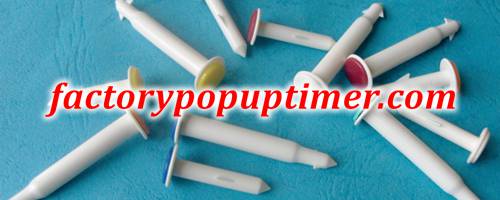
What Materials Are Used in Disposable Pop-Up Timers?
What Materials Are Used in Disposable Pop-Up Timers?
A disposable pop-up timer is a small single-use food temperature indicator, but its construction depends on several different materials working together. The housing must provide the required physical structure, the internal mechanism must respond to temperature, and the spring must provide the mechanical movement that makes the indicator visible.
For food processors, OEM buyers, importers, distributors, and other professional customers, understanding the materials used in a disposable pop-up cooking thermometer can provide useful information when evaluating product specifications and manufacturing capability.
Why Materials Matter in a Disposable Temperature Indicator
The materials used in a disposable pop-up timer are not selected simply because they are inexpensive or easy to mold. Each material has a specific function within the product.
The plastic components provide the physical structure, the internal temperature-responsive material determines the activation behavior, and the mechanical spring provides the force required for the visible pop-up action.
The finished product therefore depends on the interaction between several components rather than on one material alone.
The Main Materials Used in PopNReady™ Products
PopNReady™ disposable cooking temperature indicators are manufactured using several principal material categories.
- Food-grade Nylon PA66 for the housing and internal core
- A metal spring for the mechanical pop-up mechanism
- Temperature-responsive wax derived from food-related plant sources
The combination is designed to provide a compact, single-use temperature indication system for cooking and food applications.
Food-Grade Nylon PA66 for the Housing
The housing of the disposable pop-up timer is an important structural component. PopNReady™ products use food-grade Nylon PA66 for the housing.
Nylon PA66 is an engineering thermoplastic known for its mechanical properties and suitability for molded components. In this application, it provides the physical structure required to contain and support the internal mechanism.
The use of a defined material specification also helps provide consistency across repeated manufacturing batches.
Why the Housing Material Matters
The housing must maintain its intended shape and support the internal components during manufacturing, transportation, insertion, and cooking use.
For a disposable food temperature indicator, the material specification is therefore part of the overall product design.
A B2B customer purchasing large quantities may need to know not only what the product looks like but also which material is used for the main molded components.
The Internal Core Is Also Made From Nylon PA66
The main housing is not the only molded component that uses Nylon PA66. The internal core of PopNReady™ disposable pop-up timers is also manufactured from food-grade Nylon PA66.
The core supports the internal construction and forms part of the mechanical relationship between the temperature-responsive element and the visible button mechanism.
Using a defined material for both the housing and core helps maintain the intended dimensional relationship between these components.
The Metal Spring Provides Mechanical Force
A disposable pop-up timer needs a mechanism that can move the button from its inactive position to its visible popped position.
A metal spring provides the mechanical force required for this movement.
The spring works together with the temperature-responsive element. Before activation, the mechanism holds the button in its original position. When the designed temperature condition is reached, the mechanism releases and the spring moves the button upward.
The spring is therefore a functional mechanical component rather than simply a structural metal part.
The Spring Should Not Be Described as 304 Stainless Steel
For accurate product documentation, the spring used in these products should be described as a metal spring.
It should not be represented as 304 stainless steel when that material specification has not been established for the product.
For professional B2B documentation, accurate material terminology is preferable to adding a more specific material grade that does not form part of the actual product specification.
The Temperature-Responsive Wax Is the Key Functional Material
The most distinctive material inside a disposable pop-up timer is the temperature-responsive sensing material.
PopNReady™ products use a temperature-responsive wax derived from food-related plant sources. This material is designed to respond to a defined temperature condition and is part of the mechanism that determines when the button pops.
Unlike the housing, which primarily provides structure, the sensing material performs a temperature-response function.
How Does the Temperature-Responsive Material Work?
The sensing material is designed around a specific activation temperature.
As the food and indicator are heated during cooking, the temperature-responsive material reaches its designed response condition. The internal mechanism then releases the button, allowing the metal spring to push it upward.
This produces the characteristic visual indication associated with a disposable pop-up timer.
The principle is mechanical and temperature-responsive rather than electronic. No battery, electronic display, or digital sensor is required for the basic pop-up indication.
Different Activation Temperatures Require Different Product Specifications
Because the temperature-responsive material is directly related to activation behavior, different models can be manufactured for different activation temperatures.
Current standard PopNReady™ models include:
- LIGHT BLUE 125S and LIGHT BLUE 125L — 125°F
- YELLOW 138S and YELLOW 138L — 138°F
- ORANGE 145S and ORANGE 145L — 145°F
- GREEN 160S and GREEN 160L — 160°F
- BLUE 165S and BLUE 165L — 165°F
- RED 180S and RED 180L — 180°F
- WHITE 185S and WHITE 185L — 185°F
Custom activation temperatures can also be considered for OEM applications where a customer requires a specific temperature-response point.
What Does BPA-Free Mean for the Product?
The temperature-responsive sensing material used in PopNReady™ products is BPA-free.
BPA, or bisphenol A, is a chemical associated with certain plastics and resins. Stating that the applicable sensing material is BPA-free provides buyers with a more specific material characteristic than simply describing the product as a disposable thermometer.
For professional food-industry procurement, material information can be reviewed together with the relevant product and compliance documentation.
Heavy-Metal-Free Sensing Material
The temperature-responsive sensing material used in these products does not contain heavy metals.
This is another material characteristic that can be relevant when a product is intended for food-related applications.
For B2B customers, it is useful to distinguish specific material statements from broad claims about an entire product. Product documentation should always identify the applicable specification accurately.
Why a Food Temperature Indicator Needs More Than One Material
The disposable pop-up timer works because several different material properties are combined.
The Nylon PA66 components provide structure. The temperature-responsive wax provides the temperature-dependent response. The metal spring provides mechanical force. The components are assembled into one compact indicator.
Each material therefore contributes a different part of the product's functionality.
Material Selection and Activation Accuracy
Material selection is closely related to activation accuracy.
PopNReady™ disposable cooking temperature indicators are specified at approximately ±2°F activation accuracy.
The temperature-responsive element must therefore be manufactured consistently enough to support the specified activation behavior.
For a factory, this means material preparation and production control are directly connected to the final performance specification.
Material Consistency Matters in Bulk Manufacturing
A B2B buyer may order thousands or hundreds of thousands of disposable temperature indicators. In such cases, material consistency becomes an important part of production consistency.
If the material specifications, component dimensions, or temperature-responsive characteristics vary substantially between batches, the finished products may not perform consistently.
This is why a specialized factory needs defined material specifications and production controls rather than treating every batch as an independent small order.
Materials and OEM Customization
OEM customization does not necessarily mean changing every material used in the standard product.
Many OEM projects instead customize the product's visible and functional specifications, such as:
- Activation temperature
- PANTONE color
- Logo injection molding
- Retail blister card packaging
- Clear resealable bag packaging
Among these options, custom activation temperature is particularly connected to the temperature-responsive mechanism and therefore requires closer manufacturing consideration.
Custom Color Does Not Mean Changing the Core Mechanism
A customer may request a specific PANTONE color to match a brand identity or product packaging.
Color customization primarily affects the appearance of the applicable molded component. It does not mean that the customer needs a completely different temperature-indicator mechanism.
This distinction is useful when discussing OEM projects because appearance customization and functional customization can involve different parts of the manufacturing process.
Materials Should Be Considered Together With Product Dimensions
Material selection is only one part of the physical product specification.
PopNReady™ disposable pop-up timers are available in different sizes, including S and L versions. The dimensions of the housing and internal components must correspond with the intended product configuration.
For this reason, material, dimensions, component geometry, and assembly should be considered together when evaluating a disposable cooking temperature indicator.
Why Buyers Should Ask About Materials
A B2B purchaser evaluating a disposable meat thermometer or food temperature indicator can ask several straightforward questions about materials.
- What material is used for the housing?
- What material is used for the internal core?
- What type of spring is used?
- What is the temperature-responsive material?
- Is the applicable sensing material BPA-free?
- Does the sensing material contain heavy metals?
- Are the material specifications consistent between production batches?
- Can relevant product documentation be provided?
These questions can help the buyer understand the product beyond its external appearance.
Material Knowledge Is Part of Manufacturing Knowledge
A supplier does not become a specialized manufacturer simply by knowing the names of several materials.
The important issue is understanding how those materials function together within the finished product and how their characteristics are controlled during production.
For disposable pop-up timers, the relationship between molded Nylon PA66 components, the metal spring, and the temperature-responsive sensing material is central to the product's operation.
Why Product Specialization Matters
LIOU Manufacturing has specialized in disposable pop-up timers and single-use temperature indicators since 2006.
Long-term specialization in one product category allows manufacturing experience to accumulate around specific materials, component designs, activation temperatures, assembly requirements, quality control, and OEM requirements.
For professional customers, this product-specific knowledge can be more relevant than a supplier's ability to offer a very broad and unrelated product catalog.
Materials Are One Part of a Complete Manufacturing System
The material specification of a disposable pop-up timer should not be considered in isolation.
A complete manufacturing evaluation can include material selection, component molding, temperature-responsive material preparation, mechanical assembly, activation-temperature control, inspection, packaging, and production consistency.
Together, these factors determine whether the finished indicator can reliably meet the agreed product specification.
From Material Specification to Finished Temperature Indicator
The manufacturing chain can therefore be summarized as:
- Define the product and application requirements.
- Select and control the specified materials.
- Produce the molded Nylon PA66 components.
- Prepare the metal spring and temperature-responsive sensing element.
- Assemble the components.
- Control the activation-temperature specification.
- Inspect the finished product.
- Package according to the customer's requirements.
This relationship between material and manufacturing is what turns several individual components into a functional disposable cooking temperature indicator.
What B2B Customers Should Look For
For food processors, importers, distributors, OEM manufacturers, and other commercial buyers, a useful supplier evaluation should consider more than product photographs and a unit price.
Material transparency, defined specifications, activation accuracy, manufacturing experience, customization capability, and production consistency can all provide a clearer picture of whether a supplier is suitable for long-term commercial supply.
A disposable pop-up timer is a small product, but the materials inside it perform distinct and important functions. Understanding those materials gives buyers a more informed basis for evaluating the product and the manufacturer behind it.
Frequently Asked Questions
What materials are used in disposable pop-up timers?
PopNReady™ disposable pop-up timers use food-grade Nylon PA66 for the housing and internal core, a metal spring for the mechanical mechanism, and a temperature-responsive wax derived from food-related plant sources.
What is the housing of a disposable pop-up timer made from?
The housing is manufactured from food-grade Nylon PA66.
What is the internal core made from?
The internal core of PopNReady™ disposable temperature indicators is also manufactured from food-grade Nylon PA66.
What type of spring is used in a pop-up timer?
A metal spring is used to provide the mechanical force that moves the button upward when the temperature-responsive mechanism activates.
What is the temperature-responsive material?
PopNReady™ products use a temperature-responsive wax derived from food-related plant sources as part of the activation mechanism.
Is the sensing material BPA-free?
Yes. The temperature-responsive sensing material used in PopNReady™ products is BPA-free.
Does the sensing material contain heavy metals?
No. The temperature-responsive sensing material used in these products does not contain heavy metals.
Does the material affect the activation temperature?
Yes. The temperature-responsive material is directly related to the product's designed activation behavior, which is why activation temperature is an important manufacturing specification.
Can the activation temperature be customized?
Yes. Custom activation temperature is available as an OEM customization option for suitable applications.
Why should B2B buyers ask about product materials?
Material information helps buyers understand the construction of the product, evaluate its intended application, compare specifications, and communicate more accurately with the manufacturer when developing an OEM project.
DISCLAIMER
"Pop-up timer" is a commonly used descriptive industry term for a type of disposable cooking temperature indicator. It may refer to the functional design or operating principle of such products and does not by itself identify a specific manufacturer or brand.
PopNReady™ is an independent OEM brand of disposable cooking temperature indicators manufactured by LIOU Manufacturing. We are an independent factory-direct manufacturer and are not affiliated with any other brand or manufacturer unless expressly stated.