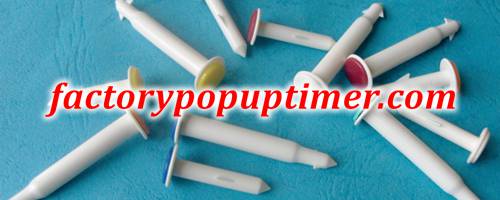
How Disposable Pop-Up Timers Are Manufactured
How Disposable Pop-Up Timers Are Manufactured
A disposable pop-up timer may look like a simple cooking accessory, but manufacturing one consistently requires control over several components, materials, temperature-response characteristics, assembly steps, and inspection requirements.
For food processors and other B2B buyers, understanding how a disposable pop-up timer is manufactured can provide useful insight into product consistency, OEM customization, and the capabilities of the factory producing it.
What Is Being Manufactured?
A disposable pop-up timer is a single-use food temperature indicator designed to provide a visible indication when the product reaches its specified activation temperature during cooking.
The finished indicator combines a molded housing, internal components, a temperature-responsive sensing material, a mechanical spring, and a visible button head.
Although the finished product is small, each part has a specific function. The manufacturing process therefore needs to control the relationship between the individual components rather than treating the timer as an ordinary molded plastic item.
The Manufacturing Process Starts With Product Specifications
Before production begins, the factory needs a defined product specification.
Depending on the model and customer requirements, this can include size, button head color, activation temperature, activation accuracy, material requirements, application, logo requirements, and packaging.
For OEM projects, the approved specification becomes the reference used throughout production. This is particularly important when the same product needs to be manufactured repeatedly for commercial customers.
Step 1: Preparing the Main Materials
The housing and internal core of PopNReady™ disposable cooking temperature indicators are manufactured using food-grade Nylon PA66.
The product also incorporates a metal spring and a temperature-responsive wax sensing material derived from food-related plant sources.
The sensing material is BPA-free and does not contain heavy metals.
Material selection is an important part of manufacturing because the components must perform correctly together during the product's operating cycle.
Step 2: Producing the Molded Components
The plastic housing, core, and button-related components are produced according to the applicable product design.
Injection molding allows the factory to reproduce the required geometry consistently across production quantities.
For a specialized disposable pop-up timer factory, dimensional consistency is important because the molded components must work together with the internal temperature-responsive and mechanical elements.
Step 3: Preparing the Temperature-Responsive Element
The temperature-responsive element is central to the operation of a disposable pop-up timer.
Its purpose is to respond when the product reaches its specified activation temperature. Different models can therefore be designed around different activation temperatures.
Standard PopNReady™ models include activation temperatures of 125°F, 138°F, 145°F, 160°F, 165°F, 180°F, and 185°F.
Custom activation temperatures can also be developed for suitable OEM applications.
Step 4: Preparing the Mechanical Spring
The internal metal spring provides the mechanical force required for the visible pop-up action.
The spring works together with the temperature-responsive mechanism. Before activation, the button remains in its original position. When the designed temperature condition is reached, the internal mechanism releases and the spring moves the button upward.
This simple movement provides a clear visual indication without requiring an electronic sensor, battery, or digital display.
Step 5: Assembling the Internal Components
Once the individual components have been prepared, they are assembled into the disposable temperature indicator.
The assembly process needs to position the temperature-responsive element, spring, core, and housing correctly so that the completed product can perform its intended function.
For mass production, assembly consistency is important because even a small variation in component positioning can affect the mechanical behavior of a precision temperature-responsive product.
Step 6: Establishing the Activation Temperature
One of the most important manufacturing characteristics is activation temperature.
The activation temperature determines when the indicator is designed to pop. For example, a RED 180 model is designed around an activation temperature of 180°F, while other models are designed for different temperature points.
Activation temperature should therefore be treated as a manufacturing specification rather than simply a color or model name.
Step 7: Controlling Activation Accuracy
A disposable cooking temperature indicator needs to activate within its specified tolerance.
PopNReady™ products are specified at approximately ±2°F activation accuracy.
Maintaining this specification requires attention to the temperature-responsive mechanism and consistency of the production process.
For B2B customers, a defined activation accuracy is particularly useful when selecting a product for recurring food-production applications.
Step 8: Inspecting the Finished Product
Manufacturing does not end when the components have been assembled.
Finished disposable pop-up timers can be checked against the approved product specifications. Depending on the production requirement, inspection can cover appearance, dimensions, component assembly, button movement, activation characteristics, and packaging.
Quality control is especially important for bulk orders because a commercial customer may receive thousands or hundreds of thousands of units from a single production program.
Step 9: Packaging the Product
The final packaging format depends on the customer's application.
For industrial and food-processing customers, bulk packaging can be the most practical option because the timers are incorporated directly into the customer's production or packaging operation.
OEM customers may instead require customized retail packaging, including blister card packaging or clear resealable bags.
Custom packaging can therefore be considered part of the overall manufacturing project rather than an unrelated after-production service.
Standard Products and OEM Manufacturing
A specialized factory can manufacture standard models while also supporting customer-specific requirements.
Standard PopNReady™ models are available in different activation temperatures, sizes, and button head colors. OEM projects can extend these options through customized activation temperatures, colors, logos, and packaging.
This combination allows a food company or distributor to begin with an established product specification and then develop a version suitable for its own application.
Why Manufacturing Consistency Matters in Bulk Production
A factory producing disposable pop-up timers for commercial customers needs to reproduce the approved specification from batch to batch.
Consistency can involve:
- Physical dimensions
- Button head appearance
- Material specifications
- Activation temperature
- Activation accuracy
- Mechanical pop-up action
- Packaging configuration
For a buyer using the indicators as part of a recurring food-production process, predictable product behavior is generally more important than receiving a product that merely looks similar to a previous order.
How OEM Changes the Manufacturing Process
OEM production introduces additional manufacturing specifications.
A customer may request a particular PANTONE color, logo injection molding, activation temperature, or packaging configuration. These requirements need to be incorporated into the production specification before manufacturing begins.
For example, a custom activation temperature may require a different temperature-responsive configuration, while custom logo injection molding requires the appropriate production tooling and design information.
This is why OEM manufacturing is more than placing a private label on an existing product.
Manufacturing Different Activation Temperatures
Disposable pop-up timers can be manufactured for different cooking applications by using different activation-temperature specifications.
Current standard models include:
- LIGHT BLUE 125S and LIGHT BLUE 125L — 125°F
- YELLOW 138S and YELLOW 138L — 138°F
- ORANGE 145S and ORANGE 145L — 145°F
- GREEN 160S and GREEN 160L — 160°F
- BLUE 165S and BLUE 165L — 165°F
- RED 180S and RED 180L — 180°F
- WHITE 185S and WHITE 185L — 185°F
The S and L versions provide different physical sizes for different product and application requirements.
Manufacturing for Poultry and Meat Applications
Disposable pop-up timers are commonly associated with poultry and meat cooking applications because they provide a simple visual temperature indication.
Commercial customers may integrate them into turkey products, chicken products, poultry packaging, ready meals, prepared food, or other food applications.
For these customers, the manufacturing process needs to support the specific product specification required by the application rather than treating every food product as identical.
Why a Specialized Factory Can Be Valuable
Manufacturing experience accumulates through repeated production.
A factory that has focused on disposable pop-up timers for many years can develop practical knowledge of component relationships, temperature-responsive materials, molding requirements, assembly, inspection, packaging, and OEM specifications.
LIOU Manufacturing has specialized in disposable pop-up timers and single-use temperature indicators since 2006.
This long-term product specialization provides a manufacturing foundation for standard products as well as custom OEM projects.
Manufacturing Is a Complete Process, Not One Production Step
The production of a disposable pop-up timer can be understood as a sequence:
- Define the product specification.
- Prepare the required materials.
- Produce the molded components.
- Prepare the temperature-responsive element.
- Prepare the mechanical spring.
- Assemble the components.
- Control the activation-temperature specification.
- Inspect finished products.
- Package according to the customer's requirements.
- Prepare the finished goods for bulk shipment or OEM delivery.
Each stage contributes to the performance and consistency of the final disposable temperature indicator.
What B2B Buyers Can Learn From the Manufacturing Process
Understanding the manufacturing process gives buyers a more practical way to evaluate potential suppliers.
Instead of asking only whether a company sells disposable pop-up timers, a buyer can ask whether the supplier understands the materials, activation mechanism, production specifications, quality requirements, OEM customization, and repeat-order requirements behind the product.
These questions can help distinguish a specialized manufacturer from a company that simply resells an existing product.
From Factory Production to Commercial Supply
The final objective of manufacturing is not simply to produce a large quantity of small plastic components. It is to deliver a repeatable product specification that can be used by professional customers in their own food-related operations.
For bulk and OEM customers, the manufacturing process therefore connects product engineering, production control, quality inspection, customization, packaging, and commercial supply.
A disposable pop-up timer may be small, but reliable production requires a manufacturing system designed around the product's specific temperature-response and mechanical requirements.
Frequently Asked Questions
How are disposable pop-up timers manufactured?
Disposable pop-up timers are manufactured by producing the molded components, preparing the temperature-responsive and mechanical elements, assembling the product, controlling the activation specification, inspecting the finished indicators, and packaging them according to the customer's requirements.
What material is used for the pop-up timer housing?
PopNReady™ disposable cooking temperature indicators use food-grade Nylon PA66 for the housing and internal core.
What type of spring is used in a disposable pop-up timer?
A metal spring is used as part of the internal mechanical pop-up mechanism.
What makes the timer pop up?
The temperature-responsive sensing mechanism responds when the product reaches its designed activation temperature, allowing the internal mechanical spring to move the button upward.
Can disposable pop-up timers have different activation temperatures?
Yes. Standard models are available at several activation temperatures, including 125°F, 138°F, 145°F, 160°F, 165°F, 180°F, and 185°F. Custom activation temperatures can also be considered for OEM projects.
How accurate are disposable pop-up timers?
PopNReady™ disposable cooking temperature indicators are specified at approximately ±2°F activation accuracy.
Can a factory manufacture custom pop-up timers?
Yes. Suitable OEM projects can include custom activation temperature, PANTONE color matching, logo injection molding, and customized retail or bulk packaging.
Why is manufacturing consistency important for bulk orders?
Bulk customers need the product to remain consistent across production batches, including dimensions, materials, activation characteristics, mechanical action, appearance, and packaging.
Are disposable pop-up timers manufactured for food processing applications?
Yes. They can be used in applications involving poultry, turkey, chicken, meat, ready meals, prepared foods, and other food-production environments where a single-use temperature indication is appropriate.
How long has LIOU Manufacturing produced disposable pop-up timers?
LIOU Manufacturing has specialized in disposable pop-up timers and single-use temperature indicators since 2006.
DISCLAIMER
"Pop-up timer" is a commonly used descriptive industry term for a type of disposable cooking temperature indicator. It may refer to the functional design or operating principle of such products and does not by itself identify a specific manufacturer or brand.
PopNReady™ is an independent OEM brand of disposable cooking temperature indicators manufactured by LIOU Manufacturing. We are an independent factory-direct manufacturer and are not affiliated with any other brand or manufacturer unless expressly stated.